
 HVAC Systems
 Heating
 Ductwork & Air Flow
 Ventilation
 Filtration
 Dehumidification
 Maintenance
 Mold
Mold Remediation & Restoration
 Pure Maintenance
 Your Home
 Building Science
 Insulation & Envelope
 Health & Safety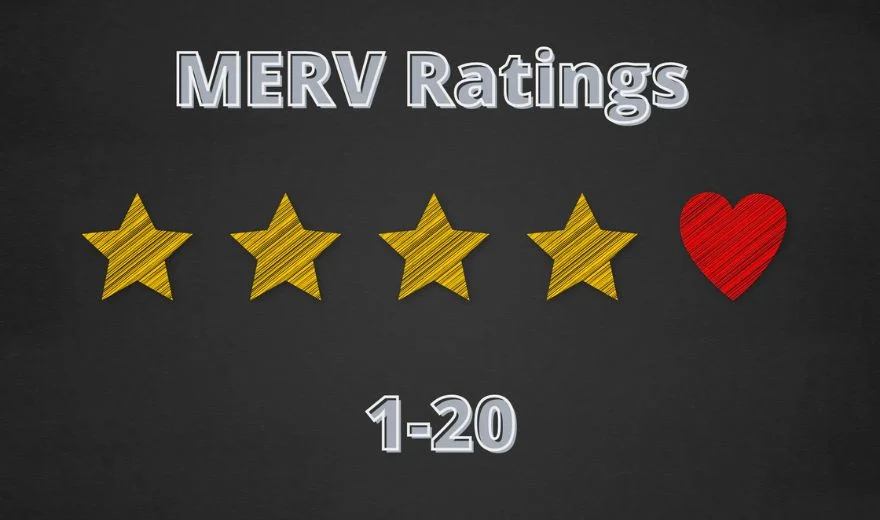
Quick answer: MERV (Minimum Efficiency Reporting Value) rates how well an HVAC filter captures airborne particles, on a scale of 1 to 16. Higher numbers catch more small particles. Higher isn’t automatically better, because denser filters can choke airflow in a system that isn’t built for them. Many homes do well with MERV 8 to 13, depending on the system and household.
In this guide
What does MERV mean?
MERV stands for Minimum Efficiency Reporting Value, a rating system from ASHRAE (the American Society of Heating, Refrigerating and Air-Conditioning Engineers). It measures how well a filter captures particles of different sizes, from lint and household dust down to very fine particles.
- Scale: Under the current ASHRAE standard, MERV ratings for HVAC filters run from 1 to 16. The higher the rating, the better the filter catches smaller particles. (Older versions of the standard also listed MERV 17 to 20, which covered cleanroom-grade filters now rated under separate standards.)
- How it works: Air passes through the filter, and the filter material (the media) traps particles. A higher MERV rating usually means denser or more advanced media that holds onto finer particles.
How do MERV ratings affect indoor air quality?
The higher the rating, the more fine particles the filter pulls out of the air your system circulates. Think of the filter as a net: the finer the mesh, the smaller the catch. Here’s roughly what each range catches:
- Low ratings (1-4): Basic filters that catch large particles like dust and lint. Plenty of smaller particles sail right through. These mostly protect the equipment, not your air.
- Medium ratings (5-8): Common in many homes. They catch more dust along with some pollen, pet dander and mold spores, usually without restricting airflow much.
- Higher ratings (9-12): Capture a larger share of smaller particles, including finer dust. A popular step up for households with pets or during heavy pollen seasons.
- Very high ratings (13-16): Capture a high share of fine particles, including many smoke particles and some bacteria. Filters in this range are used in hospitals and other demanding settings, and they need a system that can handle the extra resistance.
For filtration beyond MERV 16, homes typically use HEPA filters in portable purifiers or in bypass units attached to the ductwork, not in the main filter slot.
Can a high-MERV filter hurt your HVAC system?
It can, if your system isn’t set up for it. Higher-rated filters are denser, and in a system that isn’t designed for them they restrict airflow. Less airflow can lower efficiency, strain the blower motor, let the coil run cold enough to freeze and shorten the system’s life. In Central Texas, where the AC runs most of the year, that adds up.
- Single-speed blowers: The blower runs at one speed, and many of these systems struggle with high-MERV filters, especially if the return ducts or filter slot are small. Plenty of builder-grade systems in Austin-area subdivisions fall in this group.
- Two-stage systems: Often handle medium to high-MERV filters better, but it depends on the blower and ductwork, so have a technician check.
- Variable-speed systems: Adjust airflow continuously and are often the best match for higher-efficiency filters, as long as the ductwork is sized properly.
A larger filter cabinet (for example, a 4- or 5-inch media filter) lets you use a higher MERV rating with less airflow restriction. More filter surface means the air doesn’t have to squeeze as hard to get through.
Gold Eagle can check what your system can handle and install a media filter cabinet as part of our indoor air quality services.
What are the benefits of the right filter?
- Fewer airborne particles: Catching more pollen, pet dander and dust cuts down on what’s floating in your air, a big reason people upgrade during cedar season. For health questions, talk to your doctor.
- A cleaner house: Better filtration captures particles that would otherwise settle on your furniture.
- Some smaller particles: No filter catches everything, but higher-MERV filters capture more fine particles, including some bacteria and some smoke.
- Steadier system performance: A clean filter that matches your system keeps airflow steady, which supports efficiency and moisture removal.
How often should you change your HVAC filter?
Most home filters need replacing every one to three months, so check monthly. Even the best filter can’t do its job once it’s clogged. A few habits help:
- Change or clean filters regularly: Follow the manufacturer’s recommendation for your filter, and expect to change it more often in peak summer, during cedar season or with pets.
- Keep ducts and coils in good shape: Dust pulled in through leaky ductwork, or caked on the coil, undercuts any filter.
- Match the filter to the system: Ask your HVAC professional whether your system can handle a higher-MERV filter without losing airflow or efficiency.
What MERV rating should you use at home?
It depends on your household and your system:
- Standard comfort: MERV 8 is a solid baseline for many households.
- Pets or heavy pollen seasons: MERV 11 to 13 captures more small particles and is a popular choice if your system can handle it.
- Maximum filtration: MERV 14 to 16 gets closer to what hospitals use, but usually requires a compatible system, a deeper filter cabinet or duct changes.
What should you do next?
- Check your filter monthly, and change it more often in peak summer, during cedar season or with pets.
- Start with MERV 8, or MERV 11 to 13 if your system can handle it.
- If you want a higher rating, ask about a larger 4- or 5-inch media filter cabinet.
- Not sure what your system can handle? Book a visit and we’ll check.
Related guides: How to Improve Indoor Air Quality with Your HVAC System, Air Purification Systems: Choosing the Right One for Your Home and Indoor Air Quality Beyond Mold: Dust, VOCs, Filtration and Upkeep.
More quick answers: How Often Should You Change Your AC Filter in Central Texas? and Do Portable Air Purifiers Help During Austin Allergy Season?.
About Gold Eagle Services: This guide comes from the team at Gold Eagle Services, a family-run Austin HVAC, indoor air quality and mold remediation company founded in 2017. We’re licensed (TACLA119235 and RCO1783), insured and bonded, and we serve homes across the greater Austin area.
Need help with this in your home? Learn about our indoor air quality solutions, or call 512-489-4653 to schedule a visit.
Related: Wondering whether your AC itself puts out anything harmful? Read Do Air Conditioners Emit Harmful Gases?
More in Indoor Air Quality (IAQ)
All 30 guides Indoor Air Quality (IAQ)Do Portable Air Purifiers Help During Austin Allergy Season?A portable HEPA purifier can lower the fine particles floating in one room, such as dust, pet dander and some pollen, if it's sized…
 Indoor Air Quality (IAQ)Can a Dirty Air Conditioner Make You Sick?A dirty AC doesn't create germs on its own, but it can recirculate dust and, if the coil, drain pan or ducts stay wet,…
 Indoor Air Quality (IAQ)Moisture From Below: Slab and Pier-and-Beam Homes in Central TexasGround moisture reaches Austin homes two ways: as vapor moving up through concrete slabs, and as humid outdoor air flowing through vented crawlspaces under…