
What the words on an invoice or equipment label mean in a Central Texas home. If one describes a problem in your system, Gold Eagle can take a look: schedule online.
AFUE (Annual Fuel Utilization Efficiency)
The share of a gas furnace’s fuel that becomes heat in your house. A 96% AFUE furnace turns 96% of its gas into heat.
Air Balancing
Adjusting dampers and airflow so each room gets its share of air, so the back bedroom cools like the rest of the house.
Air Filter
The filter in your return grille or air handler that catches dust, pet hair and other particles before they reach the blower and coil. A clogged one chokes airflow and makes the system work harder.
Air Handler
The indoor cabinet that holds the blower and evaporator coil. In most Austin homes it sits in the attic, a closet or the garage.
Airflow
The air moving through your system, ducts and rooms. Too little, from a dirty filter or crushed flex duct, can ice up the coil.
Attic Equipment
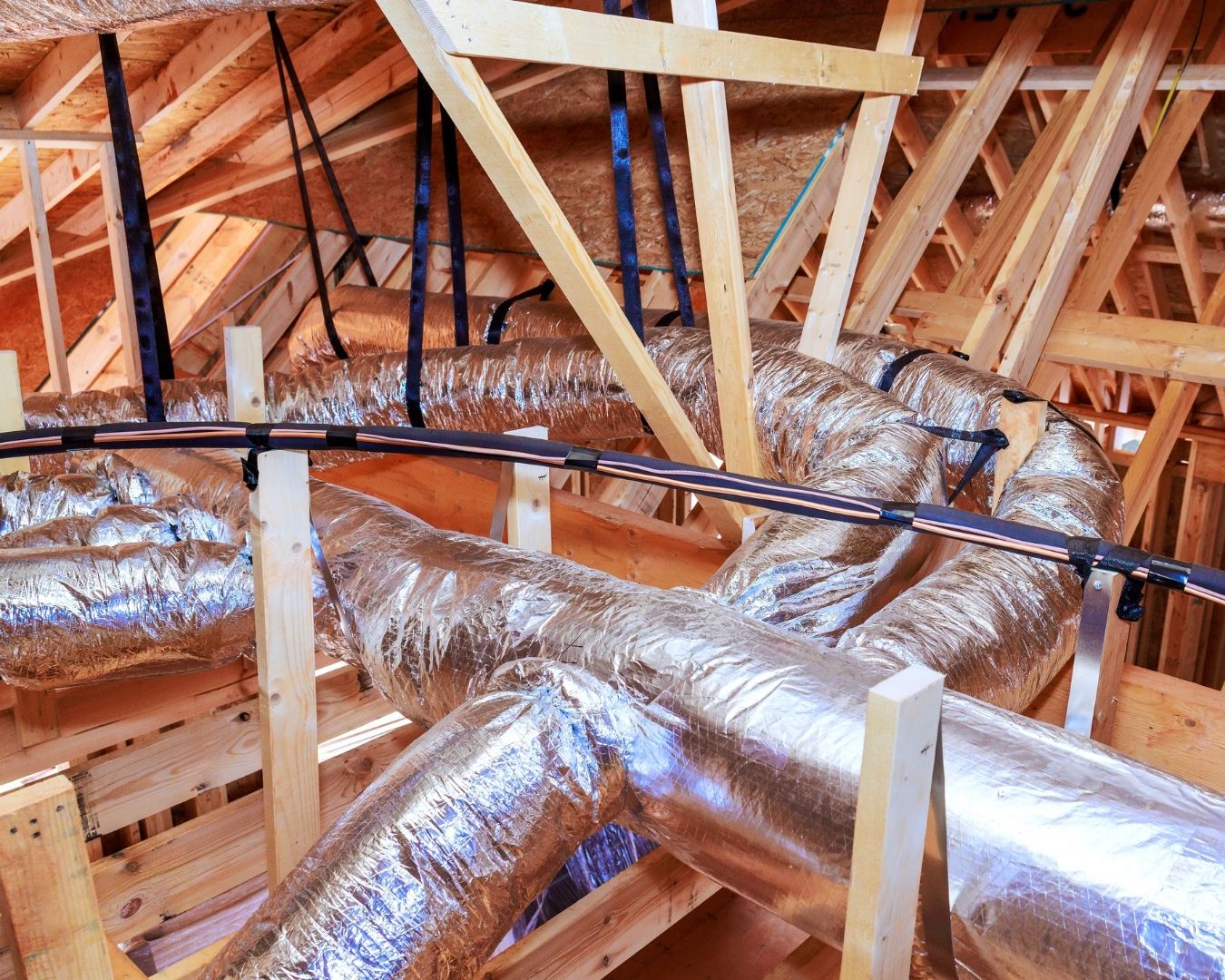
In most Central Texas homes the air handler or furnace and much of the ductwork live in the attic, where summer temperatures often climb well above 120°F. That heat is why attic insulation, sealed ducts and a clear drain line matter so much here.
Auxiliary Heat (Heat Strips)
Electric heating elements in a heat pump’s air handler that add heat on the coldest mornings and during defrost. They work well but use more electricity than the heat pump itself.
Blower Motor
The fan motor inside the air handler or furnace that pushes air across the coil, through the ducts and out your vents.
BTU (British Thermal Unit)
The unit for heat. Heating and cooling capacity is measured in BTUs per hour, and a system is sized by how many your home needs.
Building Envelope
Everything that separates inside from outside: walls, windows, doors and insulation. The tighter it is, the less your HVAC works.
Capacitor
A small electrical part that helps the compressor and fan motors start and run. Capacitors hate heat; a weak one is a common reason an AC quits in July.
Carbon Monoxide (CO) Detector
An alarm that sounds when it senses carbon monoxide, an odorless gas that gas appliances like a furnace can produce. Every home with gas equipment should have working CO detectors.
Coil
Tubing and thin metal fins that move heat. The evaporator coil absorbs heat indoors; the condenser coil releases it outdoors.
Compressor
The heart of an air conditioner or heat pump, in the outdoor unit. It pumps refrigerant around the system so heat can be moved out of your home (or, with a heat pump in winter, into it).
Condensate Drain Line
The pipe that carries off the water your AC pulls from the air. A clog backs that water up toward your ceiling.
Condenser
The outdoor unit of an air conditioner. It releases the heat pulled from your house into the outside air, which is why it blows hot.
Contactor
An electrical switch in the outdoor unit that turns the compressor and fan on and off when the thermostat calls for cooling or heating.
Damper
A movable plate inside a duct that opens or closes to control how much air reaches part of the house. Motorized dampers are what make zoned systems possible.
Dew Point
The temperature at which moisture in the air condenses into water. Any surface colder than the dew point, like a supply vent or an uninsulated duct in a humid attic, sweats.
Drain Pan and Float Switch
The primary pan under the indoor coil catches condensation, and a secondary pan under attic equipment is the backup. A float switch in the drain line or pan (or a wet switch in the secondary pan) shuts the system off if water backs up, before it stains the ceiling.
Dry Fog Treatment
A whole-home indoor air quality treatment that fills the house with a very fine, dry fog that reaches every room, closet and the HVAC ductwork. It is performed by our sister company, Pure Maintenance of Central Texas. Learn more about dry fog treatment.
Dual Fuel System
A heat pump paired with a gas furnace. The heat pump handles mild days, and the furnace takes over when it turns cold. See dual fuel heat pump systems.
Duct Leakage
Air escaping through gaps or damaged ducts. Leaky supplies cool the attic; leaky returns pull in hot attic air.
Ductboard Plenum
A box built from rigid fiberglass duct board that connects the air handler to the duct runs. It is the most common plenum in Central Texas attics, with flex ducts branching off to each room.
Ductwork
The supply and return ducts that carry air between the system and your rooms.
ECM Motor
An electronically commutated motor, a more efficient blower motor that can change speed. ECM motors use less electricity and run more quietly than older single-speed motors.
Energy Efficiency
How much heating or cooling a system delivers for the energy it uses, measured by ratings like SEER2, HSPF2 and AFUE.
ERV (Energy Recovery Ventilator)
A ventilation system that brings in fresh outdoor air while trading heat and some moisture with the stale air going out, so fresh air doesn’t undo your cooling.
Evaporator Coil
The indoor coil, where cold refrigerant absorbs heat from the air and moisture condenses into the drain pan.
Expansion Valve (TXV)
A small valve at the indoor coil that meters refrigerant into the coil, like a faucet that adjusts itself, so the system cools evenly as conditions change.
Flex Duct
Flexible round duct: a wire coil inside a plastic liner, wrapped in insulation and an outer jacket. It is common in Austin attics and works well when runs are short, straight and properly supported.
Furnace
A heating system that warms air, usually by burning natural gas, and sends it through your ductwork. See furnace replacement and installation.
Heat Exchanger
The part of a gas furnace that passes heat from burning gas to your air while keeping combustion gases out of the air you breathe. A cracked heat exchanger is a safety issue.
Heat Pump
A system that heats and cools by moving heat rather than making it. See our heat pump services.
HSPF2
Heating Seasonal Performance Factor 2, the current measure of a heat pump’s heating efficiency. A higher HSPF2 means lower heating bills.
Humidity
The amount of moisture in the air. Indoors, 40-60% is the target, with about 50% ideal in Austin summers.
HVAC
Heating, Ventilation and Air Conditioning.
HVAC Inspection
A detailed look at a heating and cooling system’s condition, performance, safety and remaining life.
HVAC Lifecycle
How long heating and cooling equipment can be expected to last, based on its age, maintenance history and how hard it works. Nearing the end of yours? Build your replacement system online.
HVAC Maintenance
Routine service that catches small problems, like a weak capacitor or a clogged drain, before they become breakdowns. See our Home Maintenance Plan.
Indoor Air Quality (IAQ)
The condition of the air inside your home: dust, allergens, mold, humidity and fresh air. For conditions outside, see our live Austin Air Quality Index.
Indoor Air Quality Assessment
A look at what shapes the air in your home: humidity, ventilation, filtration and possible contaminants.
Inverter Technology
A compressor that speeds up and slows down instead of running only full blast or off. Inverter systems hold temperature more steadily, often remove more humidity and use less energy.
Latent Heat
The part of your cooling load that comes from moisture in the air. In humid Central Texas, removing latent heat, that is, drying the air, is a big part of feeling comfortable.
Line Set
The pair of copper refrigerant lines that connect the outdoor unit to the indoor coil.
Load Calculation (Manual J)
An engineering calculation of how much heating and cooling a specific home needs, based on its size, insulation, windows and orientation. It is the right way to size a new system.
MERV Rating
Minimum Efficiency Reporting Value, a scale for how well an air filter catches airborne particles. Higher MERV catches finer particles but restricts more airflow.
Mini Split System
A ductless system whose indoor heads each heat and cool their own room or area. See ductless mini splits.
Moisture Intrusion
Unwanted water getting into a home or HVAC system, such as from sweating ducts or a backed-up drain, which can lead to mold and structural damage.
Mold Growth
Mold that grows where there is excess moisture or a leak. Gold Eagle, a licensed Texas mold remediation company, handles mold in the HVAC system (air handler, coil, drain pan, ducts); mold elsewhere goes to a general mold remediation company. See HVAC mold remediation.
Plenum
The box on the supply or return side of the air handler where air gathers before moving into or out of the ductwork.
Refrigerant
The fluid that absorbs heat indoors and releases it outdoors as it circulates in a sealed loop. A system low on refrigerant has a leak.
Refrigerant Types (R-410A and R-454B)
R-410A was the standard refrigerant for years. Newer systems use lower-impact refrigerants such as R-454B, and the two are not interchangeable.
Relative Humidity
How much moisture the air holds compared with the most it could hold at that temperature.
Return Air
Air pulled back from your rooms into the system, through the return grille and filter, to be conditioned again.
Reversing Valve
The valve in a heat pump that switches the direction refrigerant flows, which is how the same system can both cool and heat your home.
SEER Rating
Seasonal Energy Efficiency Ratio, the older measure of cooling efficiency. Higher means more efficient.
SEER2
The current version of the SEER cooling rating, tested under conditions closer to real homes. New equipment is labeled with SEER2.
Short Cycling
When a system turns on and off too often without finishing a full cycle. An oversized AC does this: it shuts off before it pulls the moisture out, leaving the house cold and clammy.
Smart Thermostat
A Wi-Fi thermostat you control from your phone. Many, like the Aerie Smart Thermostat, also track humidity and send alerts when something needs attention.
Static Pressure
The resistance air meets as it moves through the ducts, filter and coil. Too much of it strains the blower and cuts airflow.
Supply Vent
The grille that delivers conditioned air into a room. Closing vents in empty rooms unbalances the system and builds static pressure, which can bring extra humidity.
Thermostat
The control on your wall that tells the system when to heat, cool or run the fan.
Ton (Cooling Capacity)
The size of an air conditioner. One ton equals 12,000 BTUs of cooling per hour, so a 3-ton system removes 36,000 BTUs per hour.
Two-Stage System
A system that runs on a low setting most of the time and switches to high only on the hottest or coldest days, for longer, quieter and more even run times.
UV Air Purifier
A device that shines ultraviolet light inside the HVAC system, usually on the coil, to help reduce biological growth there.
Variable-Speed System
A system that adjusts its speed to match demand instead of running only full speed or off, for steadier comfort and efficiency.
Ventilation
Exchanging stale indoor air for fresh outdoor air to dilute odors and indoor pollutants.
Whole-Home Dehumidifier
A unit tied into your ductwork that dries the whole house. We choose attic or closet placement at our in-home inspection. See whole-home dehumidifiers.
Zoned HVAC System
One system set up to heat or cool different areas of the home separately, using dampers and a thermostat for each zone.