
 HVAC Systems
 Heating
 Ductwork & Air Flow
 Ventilation
 Filtration
 Dehumidification
 Maintenance
 Mold
 Remediation & Restoration
 Your Home
 Building Science
 Insulation & Envelope
 Health & Safety
 Case Study
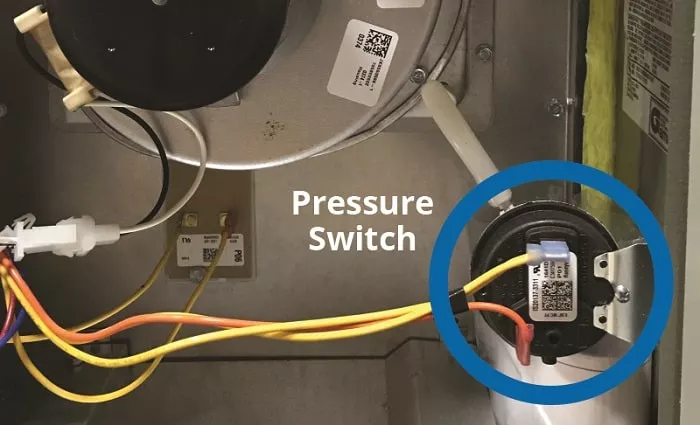
Quick answer: A pressure switch proves the furnace’s exhaust is venting safely before the burners can light. If the small inducer motor runs but the burners never ignite, the switch isn’t sensing enough draft. Usual causes: a blocked vent, water in the hose or drain trap, a weak inducer motor or a failed switch.
In this guide
- What does a furnace pressure switch do?
- What happens when the pressure switch doesn’t close?
- Why won’t the pressure switch close?
- Why does a high-efficiency furnace pressure switch fail?
- Is it safe to bypass a pressure switch?
- What can you check yourself when the furnace won’t light?
- How does a technician fix a pressure switch problem?
- What should you do next?
What does a furnace pressure switch do?
It makes sure combustion gases have a clear path out of the house before any gas is lit. Modern gas furnaces use a small fan called an inducer (or draft inducer) to pull exhaust through the heat exchanger and push it out the vent pipe. When the inducer runs, it creates a slight vacuum. The pressure switch senses that vacuum through a small rubber hose.
If the vacuum is strong enough, a thin diaphragm inside the switch pulls a set of contacts closed, and the control board knows the vent is working. Only then does it light the igniter and open the gas valve. No proof of draft, no fire. It’s one of the simplest safety checks on the furnace, and one of the most important.
What happens when the pressure switch doesn’t close?
Typical symptoms:
- The thermostat calls for heat and you hear the inducer motor start, a steady whir from the furnace.
- The burners never light.
- After a while the inducer shuts off, then tries again.
- After a few tries, the furnace locks out and stops trying for a while.
- A light on the control board flashes a pressure switch code. The code chart is usually on the inside of the blower door.
There’s a second version: the board sees the switch already closed before the inducer starts. That usually means the switch is stuck, and the furnace won’t start at all. It throws a different fault code, so write down which one you see.
Why won’t the pressure switch close?
Something is stopping the inducer from building enough draft, or stopping the switch from sensing it. Common causes:
- A blocked vent pipe or vent cap, from debris or nests, or a sagging or disconnected section of pipe in the attic.
- A cracked, kinked or loose pressure switch hose, so the switch never feels the vacuum.
- Water in the hose or a clogged port where the hose connects.
- A clogged condensate trap or drain on a high-efficiency furnace (see below).
- A weak or failing inducer motor that spins but doesn’t pull hard enough.
- A failed switch, whose diaphragm has worn or stiffened.
- Vent piping that’s the wrong size or too long for the furnace, which sometimes shows up after a new install or a remodel.
Why does a high-efficiency furnace pressure switch fail?
Yes, because high-efficiency furnaces make water. A condensing furnace, rated about 90% efficient or higher, pulls so much heat out of the exhaust that water condenses inside it. That water drains through a trap and a drain line. If the trap clogs or the drain backs up, water pools where the pressure switch is sensing, and the switch won’t close.
You can usually spot a condensing furnace by its white PVC vent pipes instead of a metal flue. In Central Texas, many attic furnaces are standard-efficiency models with a metal flue, which don’t have this drain. Either kind uses a pressure switch, though. If yours has PVC pipes and the heat quit after a long idle summer, a clogged trap is a good suspect.
Is it safe to bypass a pressure switch?
No. Never jumper or bypass a pressure switch. It’s the part that stops the furnace from lighting when exhaust can’t get out.
Bypassing it can let combustion gases, including carbon monoxide, back up into the furnace area and the house. It can also cause flames to roll out of the burner area.
If the switch keeps tripping, the fix is to find out why the draft is weak, not to silence the switch. Make sure you have working CO detectors in the home; where to put CO detectors covers placement. And if you’re wondering about the cooling side, can an AC produce carbon monoxide? answers it.
What can you check yourself when the furnace won’t light?
A few safe checks:
- Look at the vent cap outside, if it’s visible from the ground, for debris or nests. Don’t climb on the roof.
- Check the filter and replace it if it’s dirty. It won’t fix a pressure switch fault, but it rules out other problems.
- Turn the power off and back on at the furnace switch (it looks like a light switch near the unit) once to clear a lockout. If it fails again the same way, stop there.
In most Austin homes the furnace sits in the attic, next to gas lines and vent pipes. Leave the hoses, drain traps and inducer to a technician.
How does a technician fix a pressure switch problem?
By measuring the draft, not guessing. A technician uses a manometer to read the vacuum the inducer creates and compares it to the rating printed on the switch. If the draft meets the rating and the switch still won’t close, the switch is bad. If the draft is weak, the problem is in the inducer, the vent or the drain, and that’s what gets fixed. Gold Eagle’s heating technicians diagnose pressure switch faults this way across the Austin area.
Checking the inducer, vent and drain is part of a good heating tune-up, which is the easiest way to avoid the first-cold-night call. What’s included in a tune-up lists the checks.
What should you do next?
- Listen for the inducer at startup and note any error code on the furnace board.
- Reset the furnace once. If it fails the same way, leave it off and call a technician.
- Never jumper the pressure switch.
- Make sure your CO detectors are working.
- Book a heating tune-up before the first cold snap next year.
Related guides: Where Should CO Detectors Go in a Home With a Gas Furnace?, Can an Air Conditioner Produce Carbon Monoxide? and What’s Included in an HVAC Tune-Up?.
About Gold Eagle Services: This guide comes from the team at Gold Eagle Services, a family-run Austin HVAC, indoor air quality and mold remediation company founded in 2017. We’re licensed (TACLA119235 and RCO1783), insured and bonded, and we serve homes across the greater Austin area.
Need help with this in your home? Learn about our heating services, or call 512-489-4653 to schedule a visit. Also see our page on furnace control board repair in Austin.
More in Health & Safety
All 24 guides Health & SafetyWhat Is a Furnace Limit Switch, and Why Does It Shut Off the Heat?A limit switch is a heat sensor that shuts off a furnace's burners if the furnace gets too hot. It usually trips because airflow…
 Health & SafetyWhat Is a Furnace Flame Sensor, and Why Does a Dirty One Shut Off the Heat?A flame sensor is a thin metal rod in the burner flame that tells the furnace's control board the gas really lit. When residue…
 Health & SafetyWhen Is a Heating or Cooling Problem an Emergency?It's an emergency when you smell gas, a carbon monoxide (CO) alarm sounds, you see smoke or smell something electrical burning, or the AC…