
 HVAC Systems
 Heating
 Ductwork & Air Flow
 Ventilation
 Filtration
 Dehumidification
 Maintenance
 Mold
Mold Remediation & Restoration
 Pure Maintenance
 Your Home
 Building Science
 Insulation & Envelope
 Health & Safety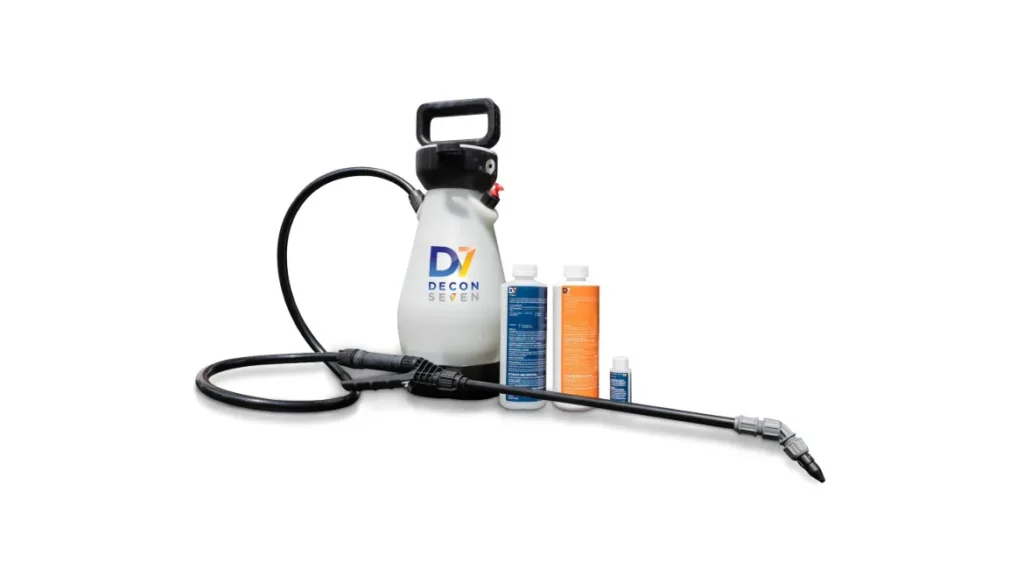
Quick answer: Decon7 (D7) is an EPA-registered disinfectant used on the surfaces inside an HVAC system, such as coils, drain pans and internal components, where bacteria and mold actually grow. It’s a targeted surface treatment for the HVAC system, not a whole-home treatment and not mold remediation.
In this guide
Many indoor air complaints don’t start in the air. They start inside the HVAC system, on the coil, drain pan, duct surfaces and other damp parts, which can send musty odors and debris into the airstream every time the system runs. In an Austin summer the AC runs for months and the coil stays wet the whole time, so those surfaces get plenty of chances. Decon7 is made for exactly that problem.
D7 is an EPA-registered disinfectant, sanitizer, deodorizer and cleaner. Technicians use it for direct surface treatment inside HVAC systems, in ductwork (for deodorizing) and in plumbing drains.
What does D7 do, and what doesn’t it do?
D7 treats surfaces, not whole houses. It’s a contact disinfectant, which means it works only on the surfaces it touches, and those are where growth actually lives.
D7 is used to:
- Disinfect HVAC coils, drain pans and internal components
- Reduce bacteria, mold and mildew on treated surfaces
- Break down the grime that shelters growth
- Neutralize odor-causing microorganisms
D7 is not:
- A whole-home mold remediation system
- A treatment for walls, attics or belongings
- A replacement for humidity control or ventilation
That difference matters. Treating a surface and remediating a building are not the same job.
Why does EPA registration matter?
EPA registration tells you the product’s claims have been checked. Disinfectants must pass testing to earn it, a process meant to verify that the product works as claimed and is safe when used according to the label.
D7’s registration confirms that its disinfection claims are surface-specific and validated. Treating mold on a coil or drain pan is very different from remediating mold in a structure. When products blur that line, homeowners often end up with half a solution.
We don’t blur it.
What’s the difference between D7 and Pure Maintenance?
D7 treats surfaces inside the HVAC system. Pure Maintenance dry fog treatment is a whole-house fogging service. At Gold Eagle Services, we deliberately keep system treatment and whole-house fogging separate.
- D7 cleans and disinfects surfaces in HVAC systems, ductwork (deodorizing) and drains. It’s fast and targeted, and it fits well into routine indoor air quality (IAQ) visits.
- Pure Maintenance dry fog treatment fills the whole house with a fine fog that temporarily reduces airborne particles and treats hard, non-porous surfaces.
The short version:
- D7 keeps the mechanical system clean.
- Dry fog treatment covers the rest of the house when conditions call for it.
They work together, and neither one stands in for the other. Neither is mold remediation for walls, attics or belongings.
How does D7 fit into the Regal Eagle Membership?
Our Regal Eagle Membership includes electrostatic fogging of D7, which charges the spray so it clings to system surfaces, as part of a proactive IAQ plan.
That lets us do four things:
- Disinfect HVAC system surfaces during routine visits
- Control odors at the source
- Reduce buildup before it becomes a bigger problem
- Keep a clean baseline inside the system
D7 is an honest, effective tool when it’s used for what it’s designed to do. Pair it with good filtration, humidity control and ventilation, and it does its part in keeping the inside of your system, and the air it moves, cleaner.
If your vents smell musty or the drain pan keeps growing slime, Gold Eagle can clean and treat the coil, drain pan and ducts as part of our indoor air quality services.
What should you do next?
- Keep up with filtration, humidity control and ventilation, since D7 works alongside them, not in place of them.
- If you notice a musty smell from the vents or slime in the drain pan, ask about a D7 treatment for the system surfaces.
- If mold may be in the building itself (walls, attic or belongings), not just the HVAC system, call a general mold remediation company for that part.
- Book a visit or call 512-489-4653 to have Gold Eagle check the coil, drain pan and internal components.
Related guides: Pure Maintenance Dry Fog Treatment: How It Works and When It’s Used, Why a “Remediated” Home Can Still Have Mold Problems and How to Improve Indoor Air Quality with Your HVAC System.
About Gold Eagle Services: This guide comes from the team at Gold Eagle Services, a family-run Austin HVAC, indoor air quality and mold remediation company founded in 2017. We’re licensed (TACLA119235 and RCO1783), insured and bonded, and we serve homes across the greater Austin area.
Need help with this in your home? Learn about our indoor air quality solutions, or call 512-489-4653 to schedule a visit.
More in Indoor Air Quality (IAQ)
All 30 guides Indoor Air Quality (IAQ)Do Portable Air Purifiers Help During Austin Allergy Season?A portable HEPA purifier can lower the fine particles floating in one room, such as dust, pet dander and some pollen, if it's sized…
 Indoor Air Quality (IAQ)Can a Dirty Air Conditioner Make You Sick?A dirty AC doesn't create germs on its own, but it can recirculate dust and, if the coil, drain pan or ducts stay wet,…
 Indoor Air Quality (IAQ)Moisture From Below: Slab and Pier-and-Beam Homes in Central TexasGround moisture reaches Austin homes two ways: as vapor moving up through concrete slabs, and as humid outdoor air flowing through vented crawlspaces under…