
 HVAC Systems
 Heating
 Ductwork & Air Flow
 Ventilation
 Filtration
 Dehumidification
 Maintenance
 Mold
Mold Remediation & Restoration
 Pure Maintenance
 Your Home
 Building Science
 Insulation & Envelope
 Health & Safety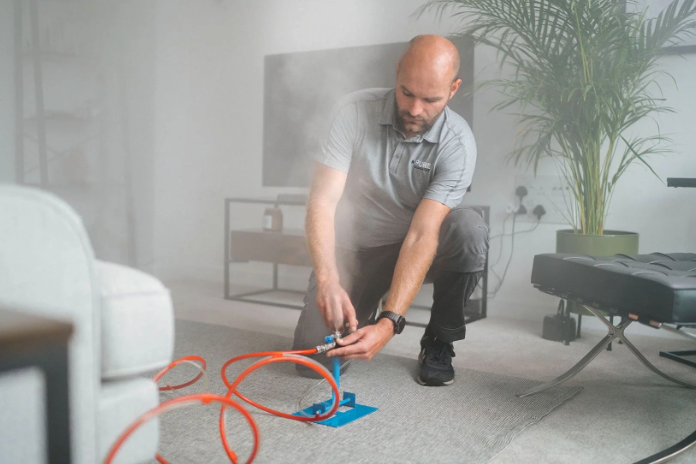
Quick answer: Pure Maintenance dry fog treatment fills a home with a fine, dry mist in two steps: a dry fog, then a surface protectant. It reaches every room and the ducts without wetting things, controls odors on hard, non-porous surfaces and temporarily reduces airborne particles. Fix moisture problems first.
In this guide
- What is a Pure Maintenance dry fog treatment?
- How does the two-step process work?
- Why does droplet size matter?
- When do homeowners use a dry fog treatment?
- How does a dry fog treatment fit with HVAC care and humidity control?
- What are the limits of a dry fog treatment?
- What should you expect from a treatment?
- What should you do next?
What is a Pure Maintenance dry fog treatment?
It’s a whole-home indoor air quality treatment that uses a patented dry fog system developed by Pure Maintenance. The system turns its treatment solutions into an ultra-fine, dry mist that fills the space. That mist reaches places ordinary cleaning can’t: cracks, crevices, closets, behind furniture and the inside of the ductwork.
Pure Maintenance describes the goal as reducing the bio-load: the microscopic particles and microbes that build up in a home’s air, on its surfaces and in its HVAC system over time.
In the greater Austin area, our sister company, Pure Maintenance of Central Texas (512-904-4646), performs dry fog treatments for lingering odors. It’s usually one piece of a larger plan where Gold Eagle handles humidity control and HVAC care.
How does the two-step process work?
A dry fog goes first, then a surface protectant. Each step has its own job.
Step 1: What does the dry fog do?
The first step fills the home with a dry fog of a hydrogen peroxide and peracetic acid solution. Peracetic acid is formed from hydrogen peroxide and acetic acid (the acid in vinegar), and it breaks down into water, oxygen and a trace of vinegar after use.
The fog helps control odor-causing microbes on hard, non-porous surfaces, neutralizes odors and temporarily reduces airborne particles as it settles.
Step 2: What does the surface protectant do?
The second step applies a protectant to treated hard surfaces. The manufacturer has renamed its products over time, so ask your technician which ones will be used in your home, and ask for their product labels and safety data sheets.
The equipment uses compressed air, precision spray nozzles and a portable control unit. Indicator strips placed around the space confirm the treatment reached the right concentration.
Why does droplet size matter?
Because tiny droplets float and big ones fall. The dry fog droplets are far finer than a human hair, so they stay suspended, spread through the space and drift into cracks, closets, ductwork and other hidden areas.
Conventional wet foggers and sprayers make larger droplets that settle out faster, which can leave gaps in coverage and damp surfaces. Dry fog droplets are small enough that the process is designed not to soak materials, and in most cases furniture and belongings can stay where they are.
When do homeowners use a dry fog treatment?
Homeowners usually book one when they want the whole home to smell fresh again, especially in places that are hard to reach. Common situations include:
- Stale or persistent odors, after the source has been found and fixed
- Homes with pets, or where smells linger after a deep clean
- Moving into a new home, or getting a home ready for sale
- Rental and short-term rental properties between guests or tenants
- Whole-home plans that also include HVAC cleaning and humidity control
How does a dry fog treatment fit with HVAC care and humidity control?
It complements them. It doesn’t replace them. Your HVAC system moves the air in your home many times a day. Clean and well maintained, it filters the air and pulls out humidity. Neglected, it pushes dust around the house. Common culprits include:
- Dirty filters that no longer trap particles well
- Leaky ducts that pull in dust and humid air from the attic
- Condensation buildup in the air handler, drain pan or ductwork
- Clogged drain lines that let water stand inside the unit
- Oversized systems that short-cycle and don’t remove enough humidity
Any treatment’s results depend on keeping moisture in check afterward. In Central Texas, where the humid season runs long, that means:
- Keeping indoor humidity below 60%, ideally around 40-50%
- Changing filters every 1-3 months, or as the manufacturer recommends
- Scheduling annual professional HVAC maintenance
- Keeping the AC drain line clear and vents unobstructed
- Using bathroom and kitchen exhaust fans that vent outdoors
- Adding a whole-home dehumidifier if your AC can’t hold humidity down on its own
What are the limits of a dry fog treatment?
It’s a useful tool, but it has four clear limits:
- It doesn’t fix moisture sources. Leaks, drainage problems, sweating ducts and high humidity have to be corrected first.
- It doesn’t repair damaged materials. Drywall, insulation, wood or other materials that are wet, rotted or damaged need to be repaired or replaced.
- It isn’t a testing service. Pure Maintenance doesn’t perform or collect lab testing. If you’d like your air tested, or you’ve had a leak, water damage or visible growth, start with an independent state-licensed professional.
- It isn’t a one-time fix for every home. New dust and pollen come in every day, cedar season included. How often a home might benefit from another treatment depends on conditions and how well moisture is controlled.
What should you expect from a treatment?
Expect a one-day job with a few hours out of the house. Here’s the usual order:
- Free consultation. A Pure Maintenance of Central Texas team member walks through the home and the HVAC system, then reviews your options with you.
- Fix the source. Leaks, drainage or humidity problems get addressed before treatment.
- Before the team arrives. Set the main HVAC system to 68 degrees to lower indoor humidity.
- Treatment day. The treatment is done in one day. People and pets stay out while it runs, and the technicians treat the whole home, including the HVAC ductwork.
- Re-entry. The home stays empty for 2 to 4 hours to air out, then you move back in the same day.
- Afterward. Keep humidity under control and keep up with HVAC maintenance to get the most out of the treatment.
What should you do next?
- Find and fix leaks, drainage problems, sweating ducts or high humidity before any treatment.
- Keep indoor humidity below 60%, ideally around 40-50%.
- Change filters every 1-3 months and keep the AC drain line clear.
- Book your annual HVAC maintenance with Gold Eagle or call 512-489-4653 so the system keeps filtering and drying the air.
Related guides: What to Expect During a Pure Maintenance Treatment (Step by Step), U.S. Army Corps of Engineers Case Study: Pure Maintenance Dry-Fog Process and How Long Do Dry Fog Treatment Results Last?.
About Gold Eagle Services: This guide comes from the team at Gold Eagle Services, a family-run Austin HVAC and indoor air quality company founded in 2017. We’re licensed (TACLA119235 and RCO1783), insured and bonded, and we serve homes across the greater Austin area.
Need help with this in your home? Dry fog treatments in Central Texas are provided by our sister company, Pure Maintenance of Central Texas. Gold Eagle handles the HVAC and humidity side. Learn about our indoor air quality solutions, or call Pure Maintenance of Central Texas at 512-904-4646 for a free consultation.
More in Pure Maintenance
All 7 guides Pure MaintenanceHow Long Do Dry Fog Treatment Results Last?Dry fog results last as long as moisture stays under control. The treatment temporarily reduces the bio-load; fixing leaks and keeping indoor humidity down…
 Pure MaintenanceMold Prevention for Rentals and Short-Term Rentals in Central TexasPreventing mold in a Central Texas rental comes down to moisture: keep indoor humidity at or below 50%, maintain the AC and its drain…
 Pure MaintenanceMold and Home Sales in Austin: Inspections, Texas Rules and TimelinesIf an Austin home inspection finds mold, find the cause and extent first, often with an independent licensed mold assessor. Larger growth needs licensed…