
 HVAC Systems
 Heating
 Ductwork & Air Flow
 Ventilation
 Filtration
 Dehumidification
 Maintenance
 Mold
Mold Remediation & Restoration
 Pure Maintenance
 Your Home
 Building Science
 Insulation & Envelope
 Health & Safety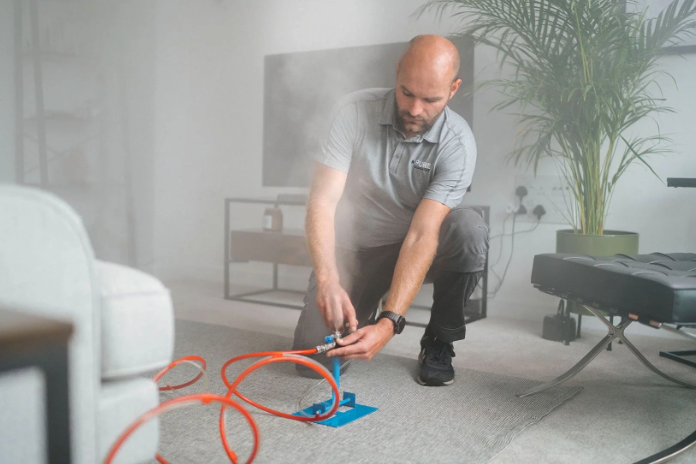
Quick answer: A U.S. Army Engineer Research and Development Center (ERDC) study tested Pure Maintenance’s two-step dry-fog process in two vacant Fort Campbell buildings. The report found large, immediate drops in airborne and surface mold spore counts, with indoor levels still about 95-99% below baseline after six months. Those results reflect the study’s specific buildings and conditions and aren’t a promise for any individual home. In Texas, Pure Maintenance isn’t a state-approved mold treatment, so Pure Maintenance of Central Texas offers dry fog as an indoor air quality treatment.
You can read or download the full ERDC report here.
What was the ERDC study, and why was it done?
It was a field test of Pure Maintenance’s patented two-step dry-fog treatment, run by the U.S. Army Engineer Research and Development Center (ERDC) in partnership with Fort Campbell and Pure Maintenance LLC. The report describes the treatment as designed to reduce airborne and surface-bound biological contaminants. The study took place in two vacant Fort Campbell buildings, a dining facility (Bldg. 2261) and a barracks administration area (Bldg. 6733), and focused on verifying performance, measuring changes in indoor air quality and tracking recurrence over six months.
The motivation: Army installations face recurring indoor contamination problems because of moisture control challenges, occupant behavior and aging infrastructure. The report notes that traditional remediation can be labor-intensive and often involves removing building materials. The study set out to test the system in real building conditions, measure short- and long-term effects, and see whether it could be used for both remediation and prevention.
How does the two-step dry-fog process work?
Step 1: InstaPURE
A peracetic acid-based solution delivered as ultra-fine droplets (described in the report as 6-8 microns). According to the manufacturer, droplets this small can reach into cracks, porous surfaces and HVAC ductwork.
Step 2: EverPURE
A surface-bonding antimicrobial that, according to the manufacturer, leaves a microscopic layer designed to inhibit microorganisms that contact the surface after application.
The fogging system uses compressed air, precision spray nozzles and a portable control unit, with indicator strips to confirm the correct concentration. The application is dry, designed not to saturate materials, and can be done without moving most contents.
Which buildings were tested?
Bldg. 2261: Dining Facility
4,000 sq ft total, with 3,700 sq ft treated. Visible contamination was present on multiple surfaces.
Bldg. 6733: Barracks Administration Area
38,000 sq ft total, with 2,800 sq ft treated in the administrative wing. Significant surface contamination was found before treatment.
Both buildings were vacant, which allowed controlled access.
How were samples taken?
With air and surface samples before treatment, then repeated over six months. The report describes baseline sampling using:
- Air samples: Zefon Air-O-Cell cassettes, 15 L/min for 5 minutes.
- Surface samples: Tape lift method.
Post-treatment sampling happened immediately after application, then at 1, 3 and 6 months. Outdoor air samples were taken for comparison, and EMLab P&K did the laboratory analysis.
Results: Bldg. 2261
Before Treatment
Indoor air: 64,126 spores/m³.
Outdoor air: 590 spores/m³.
Surfaces: Widespread Cladosporium.
After Treatment
- The report found an immediate drop in airborne contamination at all sampling points.
- Surfaces reduced to “very few” or none detected.
Follow-Up
- 1 Month: Indoor levels stayed far below outdoor counts. Surfaces remained clear.
- 3 Months: Results remained stable.
- 6 Months: Indoor air averaged 3,067 spores/m³ (95% reduction) even though outdoor levels rose thirtyfold. Two locations showed minor increases in hyphal fragments, which the report attributed to water intrusion and demolition rather than treatment failure.
Results: Bldg. 6733
Before Treatment
Indoor air: 556,057 spores/m³.
Outdoor air: 3,100 spores/m³.
Surfaces: Significant Cladosporium and some Penicillium/Aspergillus.
After Treatment
- The report found a sharp reduction in airborne and surface contamination.
Follow-Up
- 1 Month: Indoor levels remained well below outdoor background.
- 3 Months: Stable results, minimal detections.
- 6 Months: Indoor air averaged 3,044 spores/m³ (99% reduction) even though outdoor levels increased sixfold. One location saw a localized spike, which the report tied to renovation work and increased traffic. Surfaces were generally clear.
What did the study find?
According to the ERDC report:
- Immediate and sustained reductions in airborne and surface contamination for six months.
- Reductions held even when outdoor contamination levels rose significantly.
- Variations in a few locations were linked to building changes rather than loss of treatment effect.
- Surface and air sampling trends were consistent.
What did ERDC recommend next?
- Extend testing to 12-24 months to assess long-term performance.
- Test in occupied buildings with stable conditions.
- Explore preventive use in new construction.
- Consider in-house application for faster deployment and wider coverage.
What does this study tell a homeowner, and what doesn’t it?
It’s useful independent data on how the dry-fog process performed in real buildings, but it isn’t a promise for your house. The results come from two vacant buildings, treated and sampled under that study’s conditions, and the report itself recommends longer testing in occupied buildings. In any building, results also depend on fixing moisture sources, dealing with damaged materials and keeping humidity under control afterward. In Texas, Pure Maintenance isn’t a state-approved mold treatment: Pure Maintenance of Central Texas offers dry fog as an indoor air quality treatment and doesn’t perform or collect lab testing. If you have mold, a leak or visible growth, start with an independent state-licensed professional.
The bottom line
The ERDC study found that Pure Maintenance’s two-step dry-fog treatment produced immediate reductions in airborne and surface spore counts that held through six months in both test buildings, even as outdoor levels rose. For homeowners, it’s a helpful, independent look at how the process performed in two buildings. It isn’t a promise for your home, and in Texas it doesn’t make dry fog a mold treatment.
Related guides: Pure Maintenance Dry Fog Treatment: How It Works and When It’s Used, How Long Do Dry Fog Treatment Results Last? and What to Expect During a Pure Maintenance Treatment (Step by Step).
About Gold Eagle Services: This guide comes from the team at Gold Eagle Services, a family-run Austin HVAC, indoor air quality and mold remediation company founded in 2017. We’re licensed (TACLA119235 and RCO1783), insured and bonded, and we serve homes across the greater Austin area.
Need help with this in your home? Pure Maintenance treatments in Central Texas are provided by our sister company, Pure Maintenance of Central Texas. Gold Eagle handles the HVAC and humidity side. Learn about our indoor air quality solutions, or call Pure Maintenance of Central Texas at 512-904-4646 or schedule a visit.
Related Gold Eagle service: HVAC mold remediation
More in Pure Maintenance
All 7 guides Pure MaintenanceHow Long Do Dry Fog Treatment Results Last?Dry fog results last as long as moisture stays under control. The treatment temporarily reduces the bio-load; fixing leaks and keeping indoor humidity down…
 Pure MaintenanceMold Prevention for Rentals and Short-Term Rentals in Central TexasPreventing mold in a Central Texas rental comes down to moisture: keep indoor humidity at or below 50%, maintain the AC and its drain…
 Pure MaintenanceMold and Home Sales in Austin: Inspections, Texas Rules and TimelinesIf an Austin home inspection finds mold, find the cause and extent first, often with an independent licensed mold assessor. Larger growth needs licensed…