
 HVAC Systems
 Heating
 Ductwork & Air Flow
 Ventilation
 Filtration
 Dehumidification
 Maintenance
 Mold
Mold Remediation & Restoration
 Pure Maintenance
 Your Home
 Building Science
 Insulation & Envelope
 Health & Safety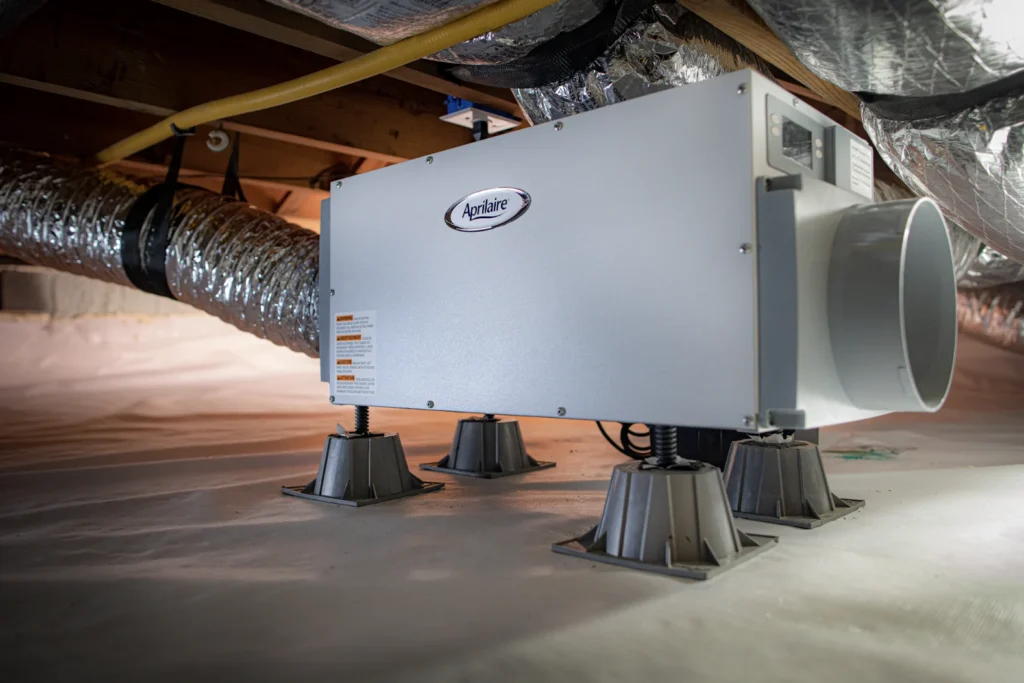
Quick answer: Many Austin homes don’t: a correctly sized, well-maintained central AC in a reasonably tight house usually keeps indoor humidity below 60 percent in summer. You’re a good candidate if humidity stays above about 55 to 60 percent with the fan on AUTO, especially on mild spring and fall days or in a tight newer home.
In this guide
Why doesn’t central AC always control humidity?
Because your thermostat runs the AC by temperature, and dehumidifying is a side effect. On a 98°F July afternoon the AC runs long cycles and pulls out plenty of water. On a 75°F rainy day in May, the house needs little cooling, so the AC barely runs, while the outdoor air is soaking wet.
Newer, tighter, better-insulated homes make this more common. They need less cooling, so the AC runs less, yet people, showers and cooking still add moisture. Oversized equipment makes it worse by shutting off before it dehumidifies.
What are the signs you need a dehumidifier?
- A hygrometer (a small humidity gauge) regularly reads above 60 percent, or above 55 percent for weeks at a time.
- The house feels clammy at 74 to 76°F.
- Closets or unused rooms smell musty.
- Supply vents or grilles sweat or drip (see why vents and ducts sweat).
- Humidity climbs when you raise the thermostat while you’re away.
What should you try before buying one?
Rule out the free and simple fixes first. Set the fan to AUTO, since a fan left ON blows water from the wet coil back into the house. Use bath and kitchen exhaust fans. Check whether your thermostat has a dehumidify setting.
Then have the system checked for a dirty coil, a blower set too fast (too much air across the coil leaves water in the air) or leaky ducts. Look for water sources too, like drainage problems or a damp crawlspace. Plenty of homes are done at this step.
Should you get a portable or whole-home dehumidifier?
A portable unit treats one room. It’s a reasonable fix for a damp bedroom or a closed-up space. You’ll need to empty the bucket or run a drain hose, and it adds some noise. ENERGY STAR certified models remove the same water with less electricity.
A whole-home dehumidifier is installed with the HVAC system, usually in the attic or a mechanical closet, and ducted to treat the whole house. It has its own humidistat, so it runs when humidity is high even if the AC isn’t cooling, and it drains to a condensate line. In an attic it needs a proper drain pan and overflow protection, like any other water-producing equipment. Gold Eagle installs whole-home dehumidifiers with that drain and overflow protection in place.
Our guide on fresh air in a tight house shows how dehumidifiers and ventilation work together.
Will a dehumidifier make the AC work harder?
A little. Dehumidifiers give off some heat as they run, and the AC has to remove it. But drier air feels cooler, so many people are comfortable a degree or two warmer, which helps offset it.
What should you do next?
- Put a hygrometer in the main living area and check it for a few weeks.
- Set the thermostat fan to AUTO and run exhaust fans during showers and cooking.
- If humidity still sits above 55 to 60 percent, try a portable unit in the dampest room.
- Book a visit to check the coil, blower speed and ducts before you buy a whole-home unit.
Related guides: Fresh Air in a Tight House: Ventilation Options for Newer Austin Homes, How Indoor Moisture Affects Your Home’s Air and Balancing Indoor Humidity for Summer Comfort.
About Gold Eagle Services: This guide comes from the team at Gold Eagle Services, a family-run Austin HVAC, indoor air quality and mold remediation company founded in 2017. We’re licensed (TACLA119235 and RCO1783), insured and bonded, and we serve homes across the greater Austin area.
Need help with this in your home? Learn about our humidity control and indoor air quality solutions, or call 512-489-4653 to schedule a visit.
More in Dehumidification
All 5 guides DehumidificationWhy Is My House Humid Even With the AC Running?Your AC only removes moisture when it runs long enough with air moving slowly across a cold coil, so anything that cuts that short…
 DehumidificationMoisture From Below: Slab and Pier-and-Beam Homes in Central TexasGround moisture reaches Austin homes two ways: as vapor moving up through concrete slabs, and as humid outdoor air flowing through vented crawlspaces under…
 DehumidificationZilkr on the Park Condo Case Study: Fixing High HumidityA 12-year-old 1.5-ton single-stage system in a 1,039 sq ft Zilkr on the Park condo let indoor humidity reach 65-72% even at 68°F. After…