
 HVAC Systems
 Heating
 Ductwork & Air Flow
 Ventilation
 Filtration
 Dehumidification
 Maintenance
 Mold
 Remediation & Restoration
 Your Home
 Building Science
 Insulation & Envelope
 Health & Safety
 Case Study
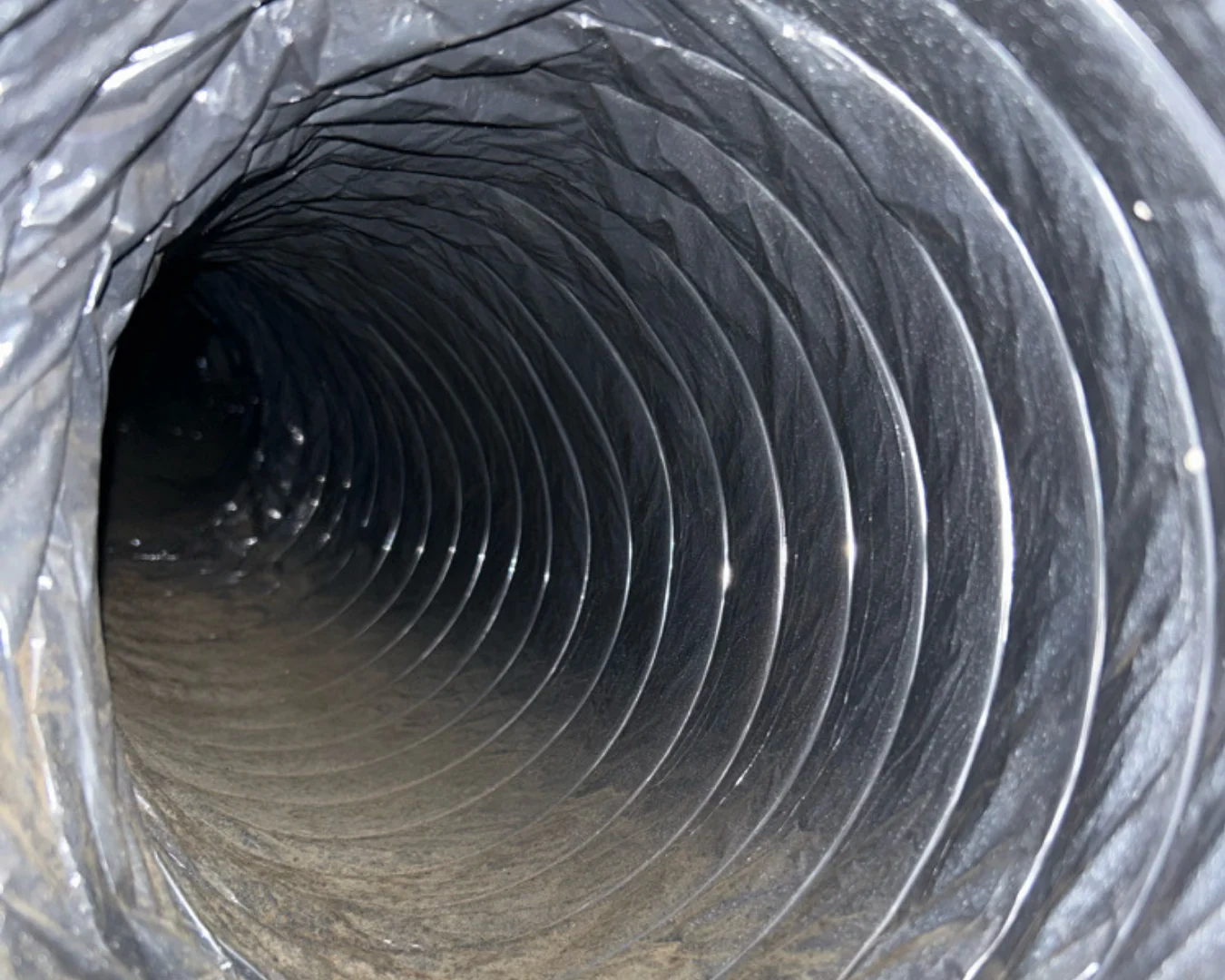
Quick answer: No. Flexible duct is a code-approved material used in most Austin homes, and it works well when it’s sized right, stretched tight, supported and kept short. The weak airflow and hot rooms people blame on flex usually trace back to installs where it sags, kinks, gets crushed or runs too long.
In this guide
What is flex duct?
The round, floppy tubes you see snaking across the attic: a plastic inner liner on a wire coil, wrapped in insulation and an outer jacket. It’s light, comes in long runs and bends around roof trusses, which is why it fills so many Austin attics.
Rigid duct, which in Central Texas almost always means fiberglass ductboard for the plenums (the boxes on the air handler) and main trunks, holds its shape but takes more time and fittings to build. How your home’s duct system works covers both.
Why do people say flex duct is bad?
Because a sloppy install wastes a lot of air. Flex is only smooth inside when it’s pulled tight. Lawrence Berkeley National Laboratory tested flex ducts under compression and found that moderate squashing, the kind common in real attics, could make air fight about four times harder to get through (engineers call it pressure loss), and heavier squashing close to ten times.
Stack sagging runs, tight bends around framing and extra length coiled in the attic on top of that, and the room at the end of the line gets a trickle.
Flex also damages easily. Boxes stored on top of it, a misplaced foot, or a jacket torn during other attic work all take a toll.
What does a good flex duct install look like?
- Tight: pulled fully taut, with no extra length.
- Supported: hung on wide straps at short intervals. Building America guidance based on the industry standard calls for supports no more than about 4 to 5 feet apart and no more than half an inch of sag per foot.
- Gently curved: wide bends instead of sharp turns.
- Short: runs as short and straight as the layout allows.
- Sealed: connections finished with mastic (a thick paste that dries like rubber) or UL 181 listed tape and plastic clamp straps, not plain cloth duct tape.
- Insulated to code: current energy codes call for R-8 (an insulation rating; higher is better) on most supply ducts in attics.
Is rigid duct better than flex duct?
For trunks (the main lines), plenums and long main runs, yes. Most systems here pair a ductboard plenum, sometimes with ductboard trunks, with flex runs to each room; the good ones keep those runs short and tight. Sizing matters as much as material; why properly sized ductwork matters explains why.
How do I know if my flex ducts are the problem?
The rooms tell you first. Watch for one room with weak airflow (see how to increase airflow to one room), rooms at the end of long runs that never keep up, or a system that sounds strained.
In the attic, look for runs lying in loops, sagging between straps, pinched at joists or wearing torn jackets. Step only on the wood framing up there, and go up in the cool of the early morning, not a July afternoon, and bring water. Looking is safe DIY; rehanging or replacing runs is a job for a pro. Gold Eagle’s ductwork technicians can measure airflow room by room and fix the worst runs in Austin-area attics, which is what duct system optimization involves.
What should you do next?
- Note which rooms run hot, cold or weak, and whether they sit at the end of long runs.
- Check the attic for sagging, kinked, crushed or torn flex runs, stepping only on framing.
- Move stored boxes off any ducts they’re resting on.
- Book a visit to have airflow measured room by room.
Related guides: How Your Home’s Duct System Works: A Central Texas Guide, Why Properly Sized Ductwork Matters for Your HVAC System and Duct System Optimization: What It Involves and Why It Matters.
About Gold Eagle Services: This guide comes from the team at Gold Eagle Services, a family-run Austin HVAC, indoor air quality and mold remediation company founded in 2017. We’re licensed (TACLA119235 and RCO1783), insured and bonded, and we serve homes across the greater Austin area.
Need help with this in your home? Learn about our ductwork design, sealing and replacement, or call 512-489-4653 to schedule a visit.
Related Gold Eagle service: Air duct cleaning
More in Ductwork & Air Flow
All 34 guides Ductwork & Air FlowShould You Put Filters on Your Air Vents?Usually no, at least not on supply vents. Air leaving a supply vent has already passed through your system's filter, and a pad over…
 Ductwork & Air FlowWhat Does a Return Air Vent Do, and Why Does It Matter?A return vent is where room air heads back to your HVAC system to be filtered, cooled and sent out again. A system can…
 Ductwork & Air FlowHow Often Should Air Ducts Be Cleaned?There's no fixed schedule. The EPA recommends cleaning ducts only when there's a reason: substantial visible mold inside, signs of rodents or insects, or…