
 HVAC Systems
 Heating
 Ductwork & Air Flow
 Ventilation
 Filtration
 Dehumidification
 Maintenance
 Mold
 Remediation & Restoration
 Your Home
 Building Science
 Insulation & Envelope
 Health & Safety
 Case Study
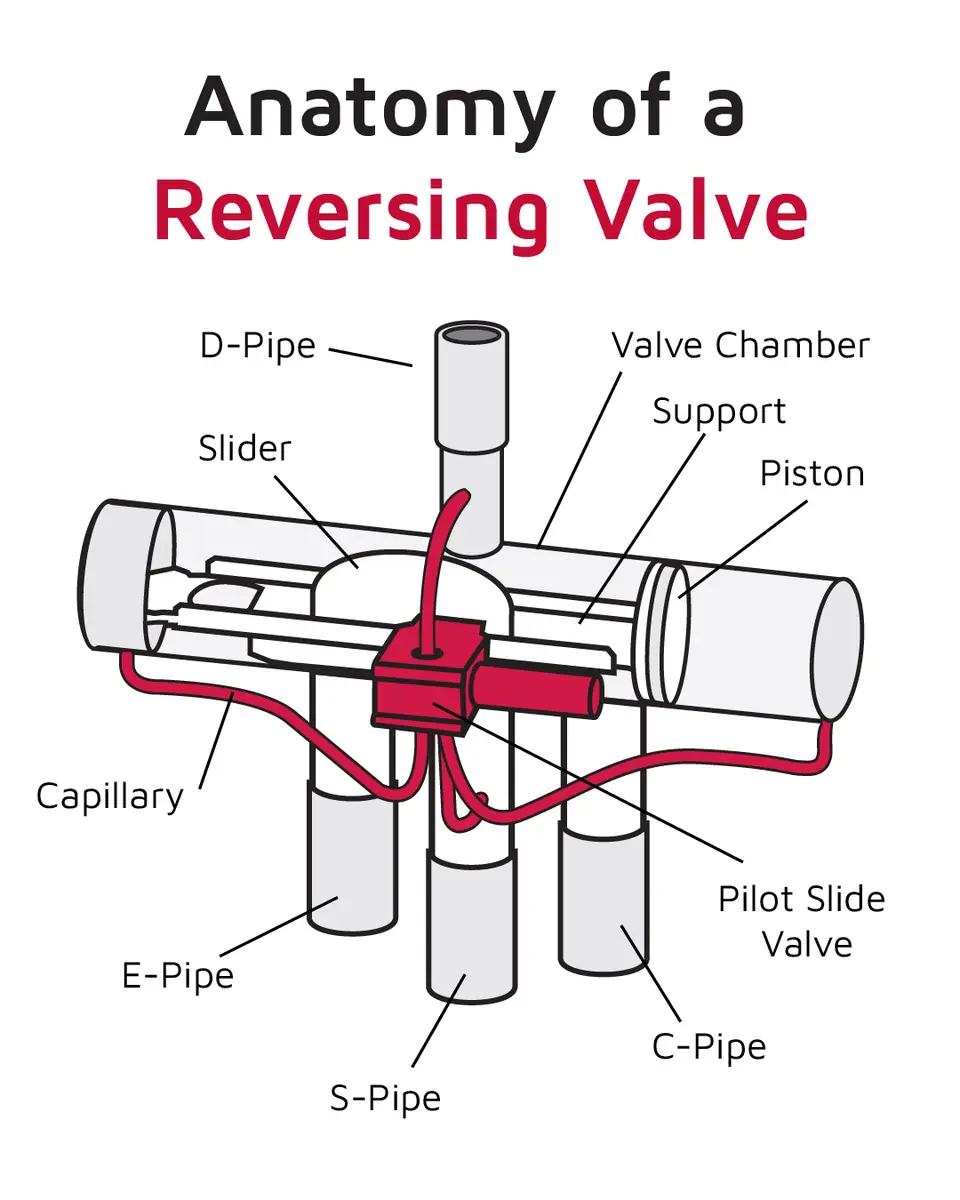
Quick answer: A reversing valve is the part in a heat pump’s outdoor unit that flips the direction refrigerant flows, so the same system can heat in winter and cool in summer. It also makes the whoosh you hear during defrost. When it sticks or leaks, the system may heat or cool weakly, or only do one.
In this guide
What does a reversing valve do?
It lets one machine do two jobs. An air conditioner moves heat out of your house and dumps it outdoors. A heat pump does the same thing in summer, then runs the process backward in winter, pulling heat from outdoor air and bringing it inside. The reversing valve is what switches between the two.
It’s a brass valve roughly the size of a soda can, with four copper lines brazed to it, sitting near the compressor in the outdoor unit. Inside is a sliding piece that sends hot refrigerant from the compressor either toward the outdoor coil (cooling) or toward the indoor coil (heating). How a heat pump works walks through the whole refrigerant loop.
How does the thermostat switch a heat pump between heat and cool?
It powers the reversing valve through a small electric coil called a solenoid, mounted on the valve. When the thermostat powers that coil, a tiny valve inside shifts, refrigerant pressure moves the main slide, and the system changes mode.
On the thermostat, that control wire is labeled O or B:
- O means the valve is powered in cooling. Most brands work this way.
- B means it’s powered in heating. A few brands use this setup.
This matters more than it sounds. Set a new thermostat to the wrong option and the heat pump cools when you ask for heat and heats when you ask for cool. It’s one of the most common “broken heat pump” calls after someone installs a smart thermostat, and it’s fixed with one setting, not a repair.
What is that whoosh sound from the outdoor unit?
Usually it’s the reversing valve doing its job. You’ll hear it when the system changes modes and, in winter, when the heat pump goes into and out of defrost. During defrost, the valve briefly switches the unit to cooling mode so hot refrigerant melts frost off the outdoor coil. The outdoor fan stops, you may see steam rising, and after a few minutes there’s another whoosh as it switches back to heat.
That’s normal on a cold, damp Central Texas morning. What’s not normal: a constant hiss, a loud bang every cycle, or a unit that never finishes defrosting.
What are the signs of a bad reversing valve?
The main sign is a heat pump that won’t switch modes or does a weak job in one mode. Common symptoms:
- Stuck in cooling: cool air from the vents when the thermostat is set to heat, often with the heat strips doing all the work. Our guide to a heat pump blowing cold air covers the other causes too.
- Stuck in heating: warm air in summer, which in a Texas July gets noticed fast.
- Weak heating and cooling: a valve that leaks inside lets some hot refrigerant slip to the wrong side, so the system runs long and never quite gets there.
- Frost that doesn’t clear: if the valve won’t shift for defrost, ice builds up on the outdoor coil. A failed defrost control or sensor can do the same thing.
How do technicians diagnose a bad reversing valve?
They rule out the easy things first. That means checking the thermostat’s O/B setting and wiring, confirming the solenoid coil is getting voltage, and testing the coil itself. A burned-out coil is a much smaller repair than a bad valve and can be swapped without opening the refrigerant system.
If the coil is fine, the technician measures temperatures on the lines going in and out of the valve and checks system pressures to see whether it’s shifting fully or leaking inside. A stuck valve can sometimes be freed; a worn or leaking one has to be replaced. Gold Eagle’s technicians diagnose and replace reversing valves across the Austin area; see our heat pump services.
Is a reversing valve worth replacing?
On a newer system, usually yes; on an older one, maybe not. Replacing the valve is a bigger job than it looks: the refrigerant has to be recovered, the old valve cut out, the new one brazed in (a high-heat soldering job) while shielding it from the torch, and the system pumped into a deep vacuum and recharged. On a newer heat pump, it’s usually a sensible repair.
On an older system, it’s worth pausing. If the heat pump is well into its second decade, uses an older refrigerant, or has had other big repairs, a new system may be the better value. We’ll tell you straight which way we’d go. Repair or replace lays out how to think it through, and Build Your System shows what a new heat pump would cost for your home.
What should you do next?
- If heat and cool seem swapped after a new thermostat, check its O/B setting first.
- Listen on a cold morning: a whoosh during defrost is normal, but note any constant hissing, loud bangs or frost that never clears.
- Write down which mode is weak and when it happens, so the technician can start with the right checks.
- Book a visit if the system won’t switch modes or runs long without catching up.
Related guides: How Does a Heat Pump Work?, Why Is My Heat Pump Blowing Cold Air in Heat Mode? and Repair or Replace Your HVAC System? How to Decide.
About Gold Eagle Services: This guide comes from the team at Gold Eagle Services, a family-run Austin HVAC, indoor air quality and mold remediation company founded in 2017. We’re licensed (TACLA119235 and RCO1783), insured and bonded, and we serve homes across the greater Austin area.
Need help with this in your home? Learn about our heat pump repair and installation, or call 512-489-4653 to schedule a visit. Also see our page on heat pump maintenance in Austin.
Related Gold Eagle service: AC repair in Austin
More in Air Conditioning
All 49 guides Air ConditioningShould You Replace Your Furnace and AC at the Same Time?Often, but not always. If both are past roughly 12-15 years old, or the furnace has a problem of its own, replacing them together…
 Air ConditioningHow Long Does a Heat Pump Last in Central Texas?Most heat pumps in Central Texas last roughly 10 to 15 years. They work year-round here, cooling through a long, hot summer and heating…
 Air ConditioningIs the Unit in Your Attic an Air Handler, and What Does It Do?If the indoor unit in your attic has no gas pipe and no vent pipe, it's almost certainly an air handler. It holds the…