
 HVAC Systems
 Heating
 Ductwork & Air Flow
 Ventilation
 Filtration
 Dehumidification
 Maintenance
 Mold
Mold Remediation & Restoration
 Pure Maintenance
 Your Home
 Building Science
 Insulation & Envelope
 Health & Safety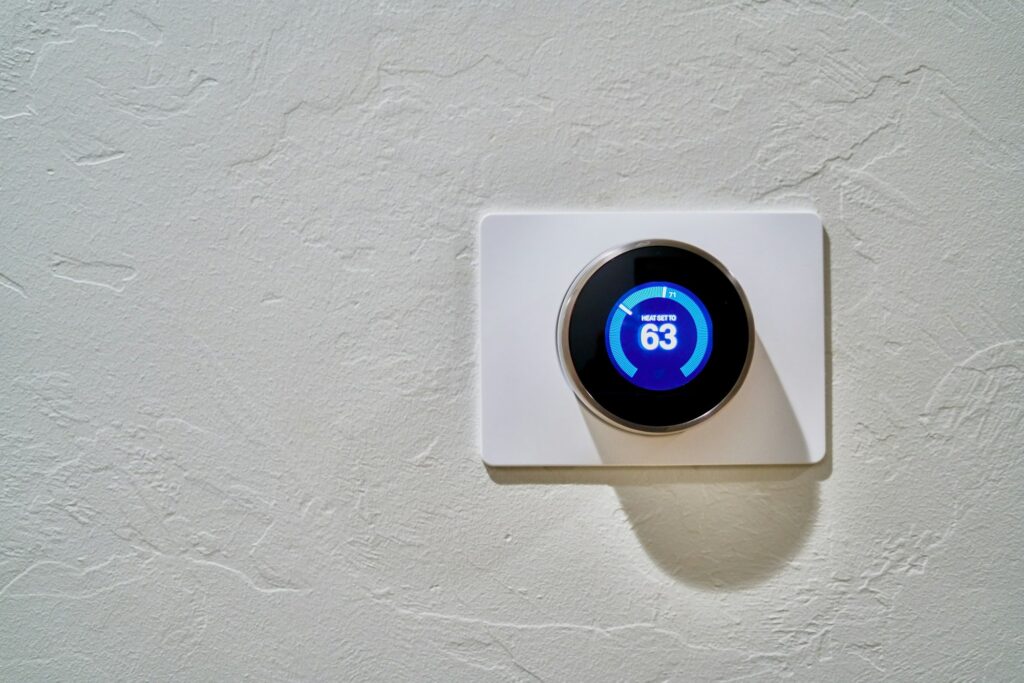
Quick answer: In summer, raise the thermostat a few degrees instead of turning the AC off, generally no higher than the mid 80s, so the house stays dry while you save energy. In winter, keep the heat no lower than about 55°F to protect pipes. The DOE says a 7 to 10°F setback for 8 hours a day can save up to 10 percent a year.
In this guide
Why not just turn the AC off while you’re gone?
Because in Central Texas the AC is also your dehumidifier. Shut it off in July and a closed-up house can climb into the 90s while indoor humidity drifts well past 60 percent, the level the EPA warns about for mold and mildew. You come home to a musty house, damp closets and a system that runs for hours to catch up.
What should you set the thermostat to on a workday?
A few degrees above your usual setting. The DOE suggests 78°F when you’re home and awake in summer, and a 7 to 10°F setback for about 8 hours a day for the biggest savings. Plenty of Austin households use a smaller setback, such as 80 to 82°F, so the house cools back down quickly on a 105°F afternoon. A schedule or a smart thermostat handles it for you, and the best summer AC setting post covers the at-home side.
Not sure how to set up a schedule? A Gold Eagle technician can walk you through your thermostat’s settings on any service visit.
What should you set the thermostat to on a summer vacation?
A few degrees above normal, generally no higher than the mid 80s, with the fan on AUTO. If your thermostat shows humidity or has a dehumidify setting, set it around 50 percent. If you have a whole-home dehumidifier, leave it on. Close blinds on west and south windows, and if your thermostat allows it, schedule it to start cooling a few hours before you get home.
How low can you set the heat on a winter trip?
No lower than 55°F, and keep the heat on. The American Red Cross recommends keeping the thermostat no lower than 55°F when you’re away in cold weather. When a hard freeze is forecast, like the one Austin saw in February 2021, keep it a little warmer, open cabinet doors under sinks on exterior walls, and ask someone to check on the house if the power goes out.
If you have a heat pump, keep cold-weather setbacks modest. Climbing back from a deep setback can bring on backup strip heat, which uses much more electricity. See aux heat vs. emergency heat.
Does the AC use more energy catching back up?
Generally no. The DOE notes that a house loses heat (or gains it, in summer) more slowly when the indoor temperature is closer to the outdoor temperature, so the energy saved while you’re away is more than the energy spent recovering. Heat pumps in cold weather are the main exception, for the strip heat reason above.
What should you do next?
- Set a workday schedule a few degrees above your usual setting while you’re out.
- Before a summer trip, set it a few degrees above normal, no higher than the mid 80s, with the fan on AUTO.
- Before a winter trip or a hard freeze, keep the heat at 55°F or above and open cabinet doors under sinks on exterior walls.
- If you have a heat pump, keep cold-weather setbacks modest to avoid strip heat, and book a Gold Eagle visit or call 512-489-4653 if aux heat still runs every morning.
Related guides: Smart Thermostats: Are They Worth It?, Aux Heat vs. Emergency Heat: What Your Heat Pump Thermostat Is Telling You and Is 79 Degrees Hot or Cold? The Best AC Setting for Summer.
About Gold Eagle Services: This guide comes from the team at Gold Eagle Services, a family-run Austin HVAC, indoor air quality and mold remediation company founded in 2017. We’re licensed (TACLA119235 and RCO1783), insured and bonded, and we serve homes across the greater Austin area.
Need help with this in your home? Learn about our air conditioning repair and installation, or call 512-489-4653 to schedule a visit.
Related Gold Eagle service: AC repair in Austin
More in Humidity & Moisture Control
All 19 guides Humidity & Moisture ControlWhy Do Your Windows Sweat, and Is It a Problem?Windows sweat when the glass is colder than the dew point of the air touching it. In Austin, outside fogging on muggy mornings is…
 Humidity & Moisture ControlDo You Need a Dehumidifier If You Have Central AC?Many Austin homes don't: a correctly sized, well-maintained central AC in a reasonably tight house usually keeps indoor humidity below 60 percent in summer.…
 Humidity & Moisture ControlWhy Is My House Humid Even With the AC Running?Your AC only removes moisture when it runs long enough with air moving slowly across a cold coil, so anything that cuts that short…